When we hear the word innovation, it is easy to picture new technology, sophisticated data systems, or a completely new way of delivering services. Those things can certainly be innovative, but innovation often begins somewhere much simpler: with a willingness to try something new.
Across Northern Minnesota, our local public health departments have demonstrated that willingness again and again. We ask whether our current processes are still working. We test new approaches, share what we are learning, and adjust when something does not work as expected.
This mindset has helped our region become a leader in several areas of public health practice. We have worked together to explore regional approaches to Foundational Public Health Responsibilities (FPHR), strengthen performance management, improve how we use and report data, build shared infrastructure, and develop more consistent systems and processes.
One example is our region’s work to translate statewide FPHR expectations into local practice. Rather than each health department interpreting new reporting expectations independently, regional and local partners have come together to compare approaches, ask questions, and develop a more consistent understanding of the work. Staff from our region have participated in statewide FPHR workgroups and pilots while bringing that information back to local teams. This creates a valuable feedback loop: local experience informs the statewide process, and statewide learning strengthens local practice.
We have also been intentional about sharing infrastructure knowledge and expertise across jurisdictions. Through regional partnerships, staff with experience in communications, data analysis, informatics, planning, community engagement, performance management, and project management can share tools, processes, and lessons learned with neighboring health departments. A resource developed in one county can become a starting point for another, rather than requiring every organization to build something entirely from scratch. The final approach may look different in each community, but the learning is shared.
These examples may not sound revolutionary, and that is part of the point. Innovation does not always require a large investment or a completely new program. Sometimes it means developing a shared reporting approach, adapting a useful tool created by a regional partner, or bringing the right people together to solve a common problem.
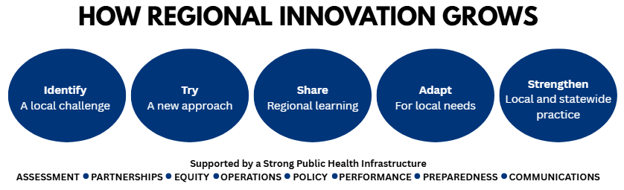
This work is closely connected to the Foundational Public Health Responsibilities. Strong public health infrastructure depends on our ability to use data, communicate effectively, build partnerships, continuously improve our work, and support a skilled and adaptable workforce. Innovation strengthens these capabilities, not by changing simply for the sake of change, but by finding more effective and sustainable ways to meet the needs of our communities.
Trying something new also requires trust. It requires people to share unfinished ideas, acknowledge what is not working, and remain open to feedback. It requires leaders who make room for learning and staff who are willing to participate in the sometimes-messy process of change.
Not every new idea will become a permanent solution. Some pilots will confirm that our existing approach is still the best one. Others will need to be revised several times. That is still valuable. Innovation is not about getting everything right on the first attempt. It is about learning enough from each attempt to make the next one better.
Northern Minnesota has built a strong culture of collaboration, resourcefulness, and shared learning. As public health continues to change, that culture may be one of our greatest strengths. We may not always know exactly what the next version of our system should look like, but we are willing to explore it together.