As a public health professional, you have likely been on social media and read a health-related post or comment and thought to yourself “That is not true!” It can be easy to want to respond instantly and correct people, but is that always the best option? Even if you do respond, how would you word it to educate while also not fueling the misinformation with unneeded attention? Answers can be found in the Sandwich Method for Debunking model. The model expresses the importance of including these four components in your response – sharing a fact, providing a warning, explaining the misinformation, and finishing with another fact.
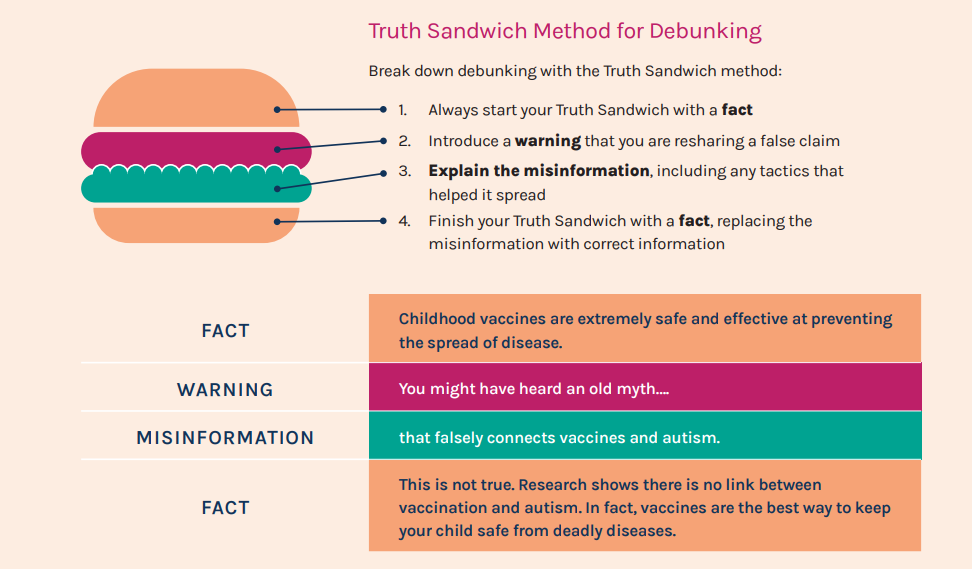
While this is a great method that could be used for responding, it is also important to establish a time when responding might not be the best option. If the comment is on your social media account you have the power in how to handle it. To guide how to handle these online situations it is recommended that you make a set of community guidelines. An example can be found below and is also located on our CHB Facebook page.
I find the guidelines helpful because I know there is consistency in what is being deleted on our page among our Facebook managers, and it is not all up to me to decide in the moment. I have a guide to fall back on if I am unsure what to do with a comment. To create community guidelines, start by making sure you understand what existing policies may exist at your agency.
If creating your own guidelines for social media comments, we recommend sitting down with a few of your coworkers and discussing what they should think should be deleted or deserving of a response. Consider getting your guidelines approved by your supervisor or legal department prior to use. From the feedback shared you can create a set of guidelines and take it a step further and share them on your media pages, if allowed, to be transparent and set expectations. Don’t hesitate to use our guide as a starting point!
**Community Guidelines**
The purpose of our page is to share public health information, education, and events that impact residents of Northeast Minnesota. While comments will not be edited, they may be deleted, without notification, if they violate Community Health Board (CHB) guidelines.
The CHB will delete a comment that interferes with other users’ ability to meaningfully engage with one another regarding the topics presented, including comments that are:
Racist, sexist, homophobic, derogatory, abusive, profane or otherwise obscene.
Personal or group-based attacks, insults, or threatening language.
Plagiarized material.
Private, personal information published without consent.
Commercial promotions, spam, and phishing.
Unverified health advice.
To learn more about how to handle public health misinformation on social media platforms, I recommend reading the Quick Guide to Public Health Misinformation by the Public Health Communications Collaborative.