See the Change Curve, Support the Person
Change happens constantly in local public health, and our reactions to it are deeply human. During NACCHO’s (National Association of County and City Health Officials) Adaptive Leadership eLearning Series, we explored a model that helps make sense of these reactions amidst ongoing systems-change work: the Change Curve.
The Change Curve is adapted from the grief curve, developed in the 1960s by Swiss-American psychiatrist Elisabeth Kübler-Ross. NACCHO adapted this framework into a workplace tool that helps us understand how people move through change, and how we can support each other in this process.
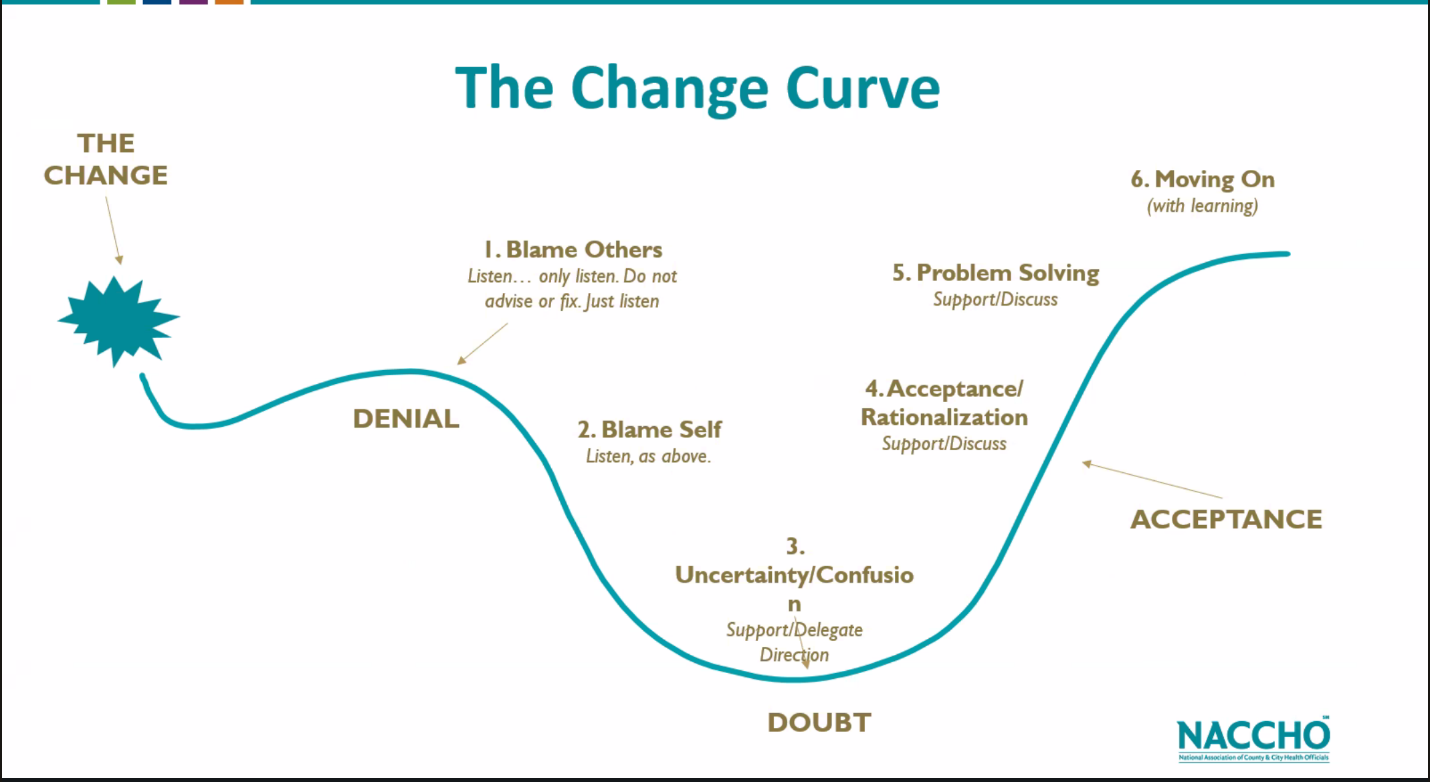
Image credit: NACCHO
So, what does the Change Curve look like in practice?
The Stages of the Change Curve
People often move through six stages:
Blaming others – People may focus on external causes, express frustration, or point to decisions made by others. Look for statements like “Why are they doing this?”
Blaming ourselves – Self-doubt often shows up here. People may worry they’re not prepared or fear they’re falling behind.
Uncertainty/Confusion – Expect lots of questions. People may feel overwhelmed or unsure how the change affects their work. The NACCHO facilitators noted that although this stage can feel messy, it is actually the first seed of acceptance – a quiet sign that someone is beginning to consider how they might adapt. It’s worth recognizing and appreciating, even if we don’t name this directly to the person.
Acceptance/Rationalization – You’ll hear curiosity and tentative openness. People start saying things like “Okay… maybe this could work.”
Problem Solving – Energy shifts towards solutions. People bring ideas, test approaches, and ask collaborative questions.
Moving On – The change starts feeling normal. People integrate new workflows and reflect on what they’ve learned.
Each stage reflects a different emotional need, and each one calls for a different adaptive response.
The Real Skill: Match Your Support to Their Stage
Here’s the key takeaway: If we can identify where someone is on the Change Curve, we can respond in a way that actually helps.
NACCHO offers clear guidance for supporting others through change:
Stages 1-2 (Blame): Just listen. Don’t fix. Don’t advise. Give people the space to express frustration. And don’t internalize it as something you need to solve.
Stage 3 (Confusion): Talk about the purpose and benefits of the change. Offer clarity without pressure.
Stage 4 (Acceptance): Begin brainstorming together! Build ideas and momentum through gentle collaboration.
Stage 5 (Problem Solving): Support people as they test and explore new ways of working.
Stage 6 (Moving On): Reinforce learning and celebrate progress.
These responses reflect core elements of Organizational Competencies, including leading partners through change, cultivating supportive work environments, communicating effectively, and creating conditions that help teams adapt.
Why This Matters Now
Across AIK (the Aitkin-Itasca-Koochiching Community Health Board) and Northeast Minnesota, we are navigating big changes. Not everyone is in the same place, and that’s normal! The Change Curve gives us shared language and practical tools to support each other through it.
Try It This Week
Identify where someone is on the Change Curve – and practice matching your support to their stage. Is your team shifting toward defining work through Foundational Public Health Responsibilities (FPHR)? Navigating dwindling grant funding? Did IT implement a new systems update? Suddenly unsure what resources you can rely on for evidence-based vaccine recommendations? These are all moments where people may be at different stages of the Change Curve. Identifying where someone is and aligning your response is one of the most effective ways to reduce friction, build trust, and help our teams navigate change with confidence.