Implementing a program takes community partnerships, capacity, funding and so many other resources. By the time the program is implemented, wouldn’t it be nice to know if it is working? It’s easy for evaluation to get missed. Maybe you are feeling too burnt out from actually implementing the program. Or maybe you are feeling nervous that you put in all that effort only to get results different from what you were hoping to find. Evaluation can be daunting. It helps to remember that evaluation doesn't just measure success or failure. It is a process to help us understand what a program is doing, what could be improved, and whether the program is contributing to meaningful outcomes.
Step One: Pick a program/activity/etc. to evaluate.
Step Two: Decide who should be a part of the evaluation planning such as:
Community partners
Those impacted by the program
Core program planning members
A member who was not a part of the planning process to bring in a new perspective
Step Three: Work with your identified evaluation team to fill out the two tables below. The tables focus on the following areas:
What am I evaluating? (The process or the outcome)
How do I know if the program is working? (Indicator)
Do I need more information? (See the last 4 columns, in green, in the first table below)
What am I doing with that additional information? (See the blue data analysis questions in the second table)
Who is telling me if it is working? (Data Source) *go to step four to learn more.
Step Four: Identify meaningful data sources.
Start by looking at preexisting data sources.
Bridge to Health Survey, Minnesota Student Survey, County Health Rankings, etc.
Consider training or other opportunities to help better comprehend preexisting data sources.
After reviewing data sources, decide if you need to collect new or additional data.
Consider conducting surveys, focus groups, photovoice, or dot voting
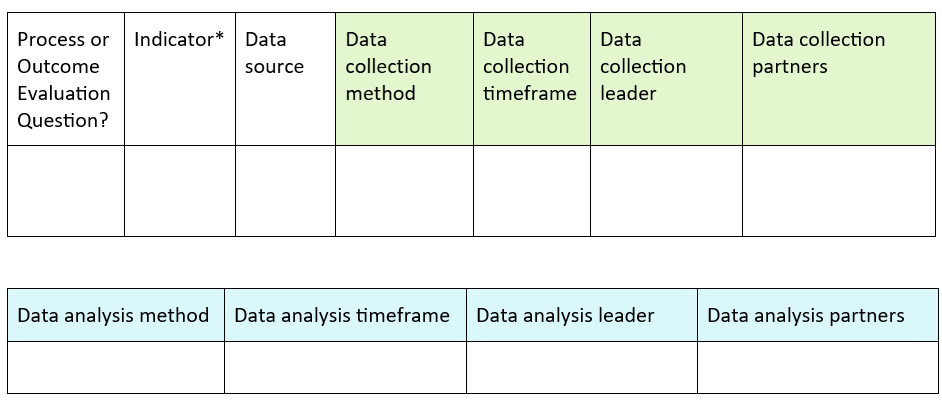
Table from the MDH SHIP 6 Locally Led Evaluation Plan, 2026
By taking this planning process step by step, we are more able to find out if our public health programs are making a positive difference in people’s lives and communities. This is meant to be a straightforward, thoughtful process that could easily go on your next planning or coalition agenda meeting to work through with partners.
It is recommended to start thinking about evaluation from the very beginning of the program planning process and yet it can still occur periods after the program is implemented as well. Feel free to add additional columns to the tables to create a more robust evaluation plan or adapt it to other areas outside of programming such as policy.
To learn more about evaluation data tips visit Talking Data Equity > We All Count to watch their recordings on topics like addressing survey fatigue, good survey questions, and more. For Carlton, Cook, Lake, St. Louis evaluation planning support email Mary Parsatoon at parsatoonm1@communityhealthboard.org