If I asked you to raise your virtual hand if you love coffee, I am sure many of you reading this would have a hand up. Now what if I asked you to raise your hand if you love conducting assessments for public health programs? While assessments are important and can be enjoyable, there may not be as many hands that quickly raise up. What if you could combine the two for a public health assessment tool? The 100 Cups of Coffee assessment model does just that. Here is how it works.
Step 1: Create a conversation template (similar to a survey). A mix of qualitative and quantitative data questions are recommended.
Step 2: Decide on the number of people you need to engage to gain insights on your topic and with your audience. It does not have to be 100 people just because it is in the name. You could have 50 cups of coffee or 1000 cups of coffee, depending on how many people would provide a good representation of your desired audience.
Step 3. Next, engage your audience. This could be by creating flyers, attending community events, using word of mouth, etc.
Step 4. Meet up in a place where participants would feel comfortable and conduct the conversation over a cup of coffee.
This model can create for a natural, comforting environment for a more informal way to conduct a conversation which can lead to deeper understanding and connection.
The 100 Cups of Coffee is an assessment tool that can easily be adapted to fit the needs of your evaluation. We spend a lot of time planning and implementing--it can sometimes be hard to get to the finish line that is evaluation. This method could be a key part of any public health program evaluation. Use the program model evaluation below to support your evaluation needs and see how the 100 cups of coffee model could fit into the process.
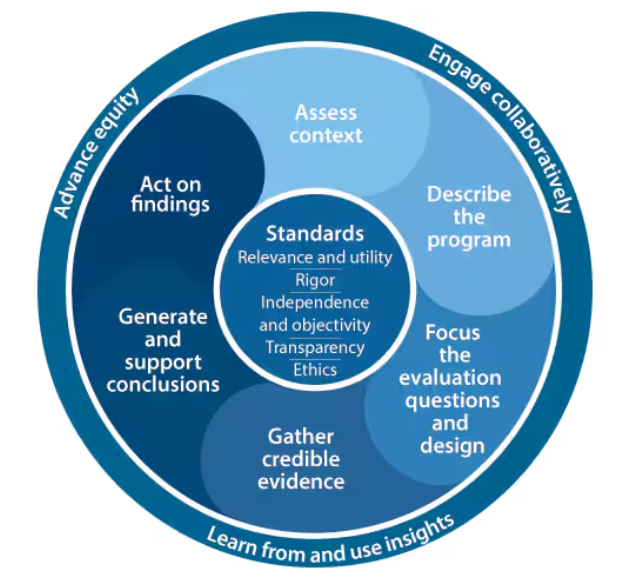
Image Source: CDC 2024
Notice how vague the model is? That is because each evaluation is going to look a little different depending on the audience that it is being served and the goals you hope to achieve.
You might use this method to evaluate public health programs, but it can also be used to collect data on issues that are impacting a community. For example, a Duluth Food Justice Policy team facilitated by the Duluth Branch NAACP, Health and Environmental Equity Committee with support from St. Louis County Public Health and Northeast SHIP have been hard at work with a network of partners for two years. They are using the 100 Cups of Coffee model to gather stories about food access in Duluth neighborhoods with the goal of creating policy change. They are proud to share that their network of partners has conducted 100 interviews with people using this method.
Try looking at your next survey and ask yourself, could this be a conversation over a cup of coffee? To learn more about qualitative methods for program evaluation check out this Community Toolbox article on Qualitative Methods to Assess Community Issues.